

Biodegradable cosmetic packaging for skincare products: sustainable alternatives
The question of what happens to a packaging material once its function is fulfilled rarely enters the design conversation at the right moment.
In skincare, the primary focus is on performance, compatibility and aesthetics, with the behaviour of materials over time being a secondary consideration. Yet the moment a product leaves the shelf, a new phase begins that depends entirely on how the packaging was conceived from the outset.
Biodegradable cosmetic packaging is a result of this change of perspective. The design process requires thinking beyond the immediate use of the object to consider how materials will interact with their environment once their role is complete. A material's origin, composition and structural design all contribute to defining how and when it can return to the system it comes from.
Therefore, working with biodegradable solutions involves more than simply selecting alternative materials.
In this context, materials such as wood and advanced biopolymers offer new possibilities, particularly when incorporated into packaging designs that balance technical requirements with a more sustainable lifecycle approach.
What does “biodegradable” really mean for packaging for cosmetics?
Although the term biodegradable is often used as shorthand for sustainability, its actual meaning depends on how a material behaves under specific environmental conditions over time.
Technically, a biodegradable material can be broken down by microorganisms into natural substances such as water, carbon dioxide and biomass. But here's the thing: this process isn't instant or universal. It depends on factors such as temperature, humidity, oxygen availability and the presence of active microbial environments. Without these conditions, even materials designed to biodegrade may remain stable for extended periods.
This distinction becomes clearer when compared to adjacent terms that are frequently used interchangeably:
“Bio-based” refers to a material's origin, indicating that it is derived from renewable biological sources, but not necessarily that it will biodegrade;
“Compostable materials”, on the other hand, are a more controlled subset that are designed to decompose within defined timeframes under industrial or home composting conditions. Often, specific infrastructures are required to facilitate this effectively.
In cosmetic packaging, these differences have practical implications. Skincare products require protection from light, air and contamination, often necessitating multi-component systems that combine various materials and functional elements. Closures, inserts and dispensing systems must ensure precision and stability with repeated use while remaining compatible with sensitive formulations.
In this situation, biodegradability is an important factor that must be taken into account. It involves aligning material selection, structural design and expected lifespan so that performance during and after use remain part of the same design logic.
Material strategies for biodegradable skincare packaging
Selecting materials for biodegradable skincare packaging requires striking a balance between their origin, performance and behaviour over time. The characteristics of each option influence how the packaging performs during use and evolves once its function is complete.
Bio-based and biodegradable polymers
Bio-based and biodegradable polymers offer new possibilities for cosmetic packaging, especially when they are derived from secondary resources rather than virgin raw materials.
At mPackting, tracefree biopolymers are developed using wood processing residues to transform by-products into functional materials with controlled properties. This approach enables the composition of materials to be adjusted according to technical requirements, including structural performance, surface quality and tactile perception.
The behaviour of these polymers is not left to chance. Their composition, density and thickness are defined to ensure consistency during use and influence how they interact with environmental conditions over time. Reduced material mass, for instance, can support a more efficient degradation process, aligning performance with lifecycle considerations.
Beyond their environmental profile, these materials also enable a high level of design control. Colour is integrated directly into the material to avoid the need for superficial coatings and surface finishes such as soft-touch effects are engineered to enhance interaction without compromising repeatability on an industrial scale.
In this way, bio-based polymers form part of a broader material strategy where sustainability, functionality and sensory experience are developed together, rather than being treated as separate layers.
Wood as a naturally biodegradable material
Wood is one of the most well-known materials used in biodegradable packaging, combining its natural origin with predictable behaviour over time. Its ability to reintegrate into biological cycles is intrinsic to the material itself and does not require additional treatments or specific industrial conditions.
At the same time, wood can be processed with a high level of industrial precision. Machining, turning and finishing enable it to meet the dimensional tolerances required for cosmetic packaging, ensuring consistent performance across large production volumes. This balance between natural variability and controlled manufacturing enables an organic material to be transformed into a reliable structural component.
Beyond its environmental profile, wood also contributes to the sensory and visual identity of the product. The grain, density and surface finish define how the packaging is perceived, creating a direct connection between the material's origin and the user's experience.
Intelligent combination of materials
Biodegradable packaging rarely relies on a single material. Skincare products often require different components to be integrated, each one selected for a specific function within the overall system.
Glass, for example, provides stability and compatibility with formulations, ensuring protection and preserving product integrity. Wood introduces a naturally biodegradable structural element, while bio-based polymers offer greater flexibility in terms of shaping, colour and surface performance.
Each material plays a distinct role and their combination is defined through a systems-based approach. Thickness, interfaces and compatibility are all engineered to ensure consistent performance during use, while material choices support a more responsible lifecycle.
Biodegradability is incorporated into a broader design strategy where materials are combined according to their function, behaviour and interaction within the packaging architecture.
From theory to practice: biodegradable packaging
Translating biodegradable strategies into practical packaging involves shifting from theoretical materials to applied systems, where every decision is evaluated based on performance, manufacturability and consistency. It is through concrete applications that materials reveal their actual potential, integrating structure, surface and behaviour over time.
Rivulet: traceless biopolymers and reduced material design
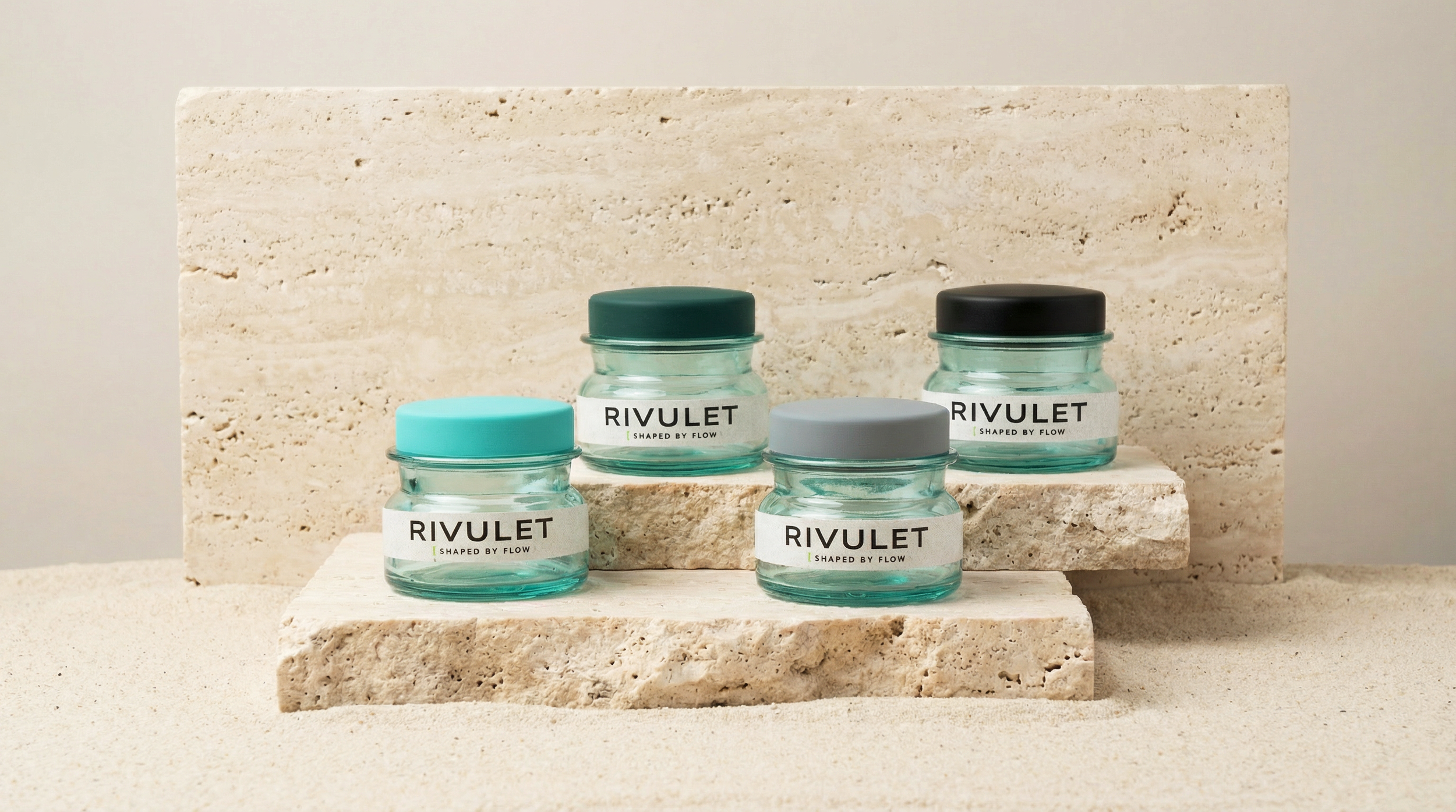
The Rivulet collection explores the use of trace-free biopolymers derived from wood processing residues, transforming industrial by-products into functional packaging components. The material composition can be adjusted to define properties such as rigidity, surface feel and colour according to the intended application.
Colour is integrated directly into the material, creating a natural yet articulated palette without the need for external coatings. The surface finish is engineered to achieve a soft-touch effect that enhances interaction while maintaining consistency across production.
A key aspect of this approach is material reduction. Caps are designed to be approximately 2 mm thick, limiting mass while preserving structural performance. This reduction influences the material's behaviour over time, enabling a more efficient biodegradation process due to the lower volume that needs to break down.
Through a combination of origin, composition and controlled design, Rivulet shows how biodegradable materials can be used in a consistent packaging system.
Alpine Dew: wood as a structural, biodegradable element
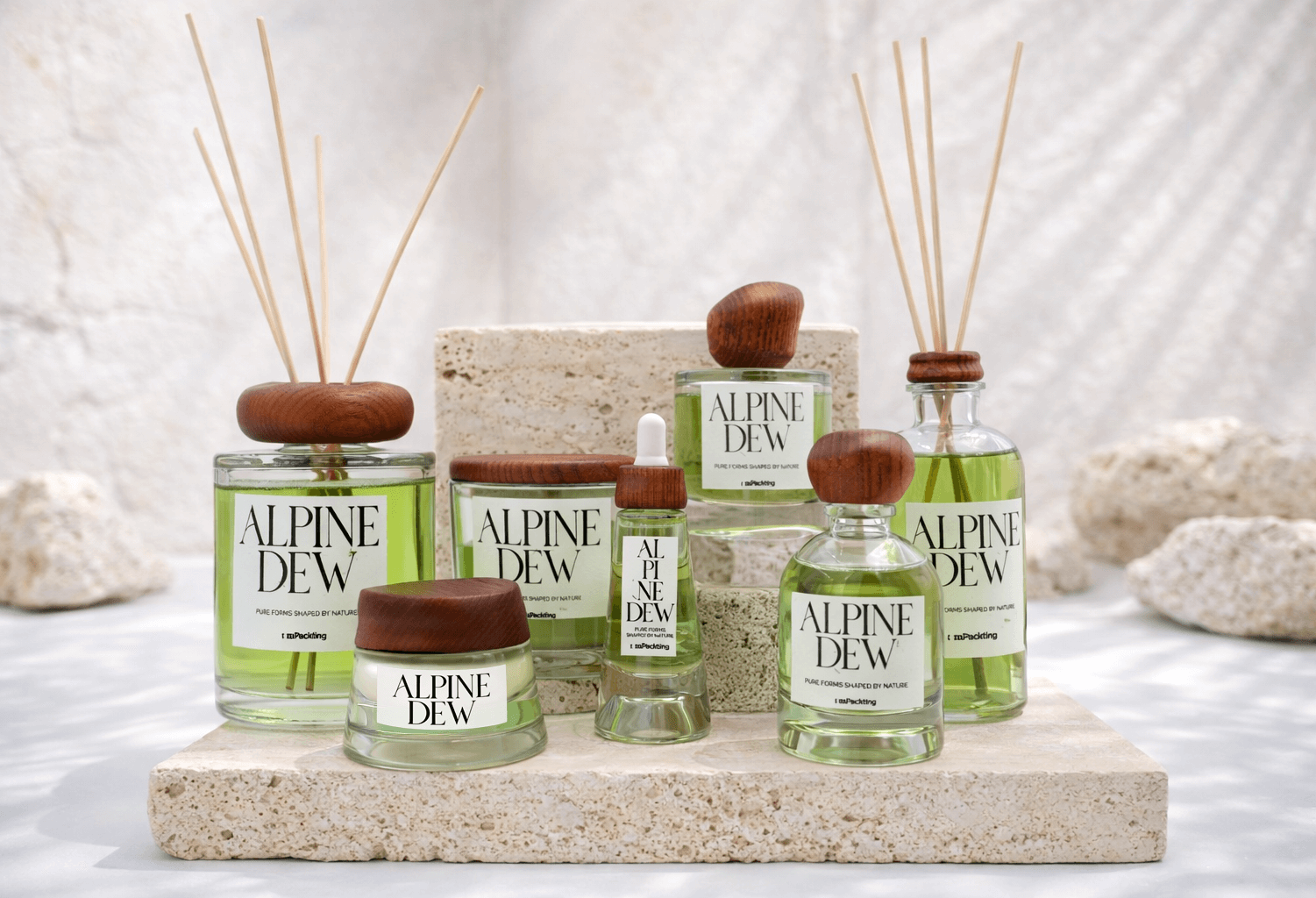
The Alpine Dew collection embraces biodegradability by using FSC-certified wood as the main structural material.
The manufacturing process enables the wood to achieve the level of precision required for cosmetic packaging, ensuring compatibility with closures and repeated use cycles. Surface finishing enhances the natural grain, reinforcing the connection between the material's origin and the final product's appearance.
The closure system incorporates WoodPin™ technology, which combines wood and cork using a mechanical solution that eliminates the need for adhesives. This approach maintains material purity while ensuring functional performance.
At the end of its life, the wood retains its natural capacity to reintegrate into the environment, thus completing a lifecycle that is consistent with its origin.
Designing biodegradable materials
Designing biodegradable packaging involves working with materials from the outset to understand how they behave, interact and evolve over time. The origin, composition and structure of the materials all become part of the same design logic, shaping both performance and lifecycle.
At mPackting, we use this approach to develop complete packaging systems where all materials are selected and integrated with precision. Each element is designed to work within a coherent architecture that balances technical requirements, material integrity and end-of-life behaviour.
Biodegradability becomes one possible outcome of a broader material strategy where reduction, compatibility and system design determine how the packaging performs after use.
If you are exploring new materials for your skincare packaging, our team can support you in developing solutions that combine design, engineering and responsible material choices.
Get in touch at mpackting.com.
