

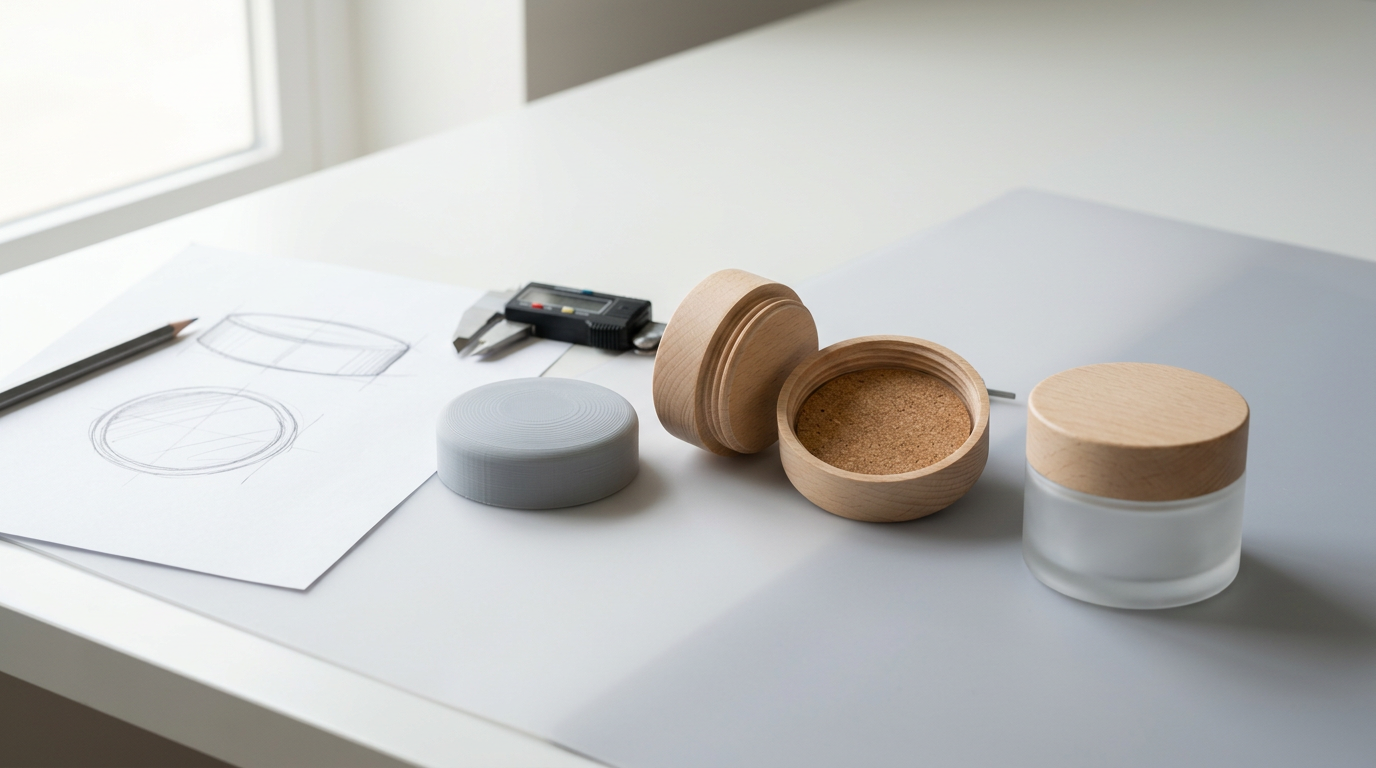
A cosmetic packaging manufacturer designs, engineers and produces the components of your pack, instead of only reselling catalogue items. For an indie brand, the right one helps you launch a premium, sustainable pack on a realistic budget, and stays involved from the first sketch through production.
What a cosmetic packaging manufacturer does for an indie brand
The words manufacturer and supplier are often used as if they meant the same thing. They do not. A supplier or distributor sells packaging that already exists, usually from a catalogue. A manufacturer makes it: it works on materials, shapes and assembly, and it can adapt the product to a brief.
For a new brand, that difference decides how much room there is to stand out. A catalogue pack is available to everyone, including your competitors. A manufacturer can customise materials, finishes and details so that the pack is recognisably yours.
What indie brands need that large brands do not
A clear starting point. Most new brands have no packaging department, so they need a partner who turns an idea or a sketch into something feasible.
Speed and clarity. A small team cannot absorb long, unclear sourcing. Answers on materials, samples and process need to be direct.
Room to grow. First runs are small and ranges expand. Choose a packaging family you can extend, instead of one-off parts that lock you into a single product.
Visible differentiation. Shelves and feeds are crowded. The pack has to communicate quickly, and materials and finishes do much of that work.
Credible sustainability. A new brand has no track record to lean on, so every claim needs documents behind it.
An established brand has people and processes to absorb a weak supplier. A new brand usually does not, which is why the choice of partner weighs more at launch.
Three ways to work with a manufacturer
A brand can approach a manufacturer in three ways. The table compares them. The ratings are our own qualitative assessment, not measured values.
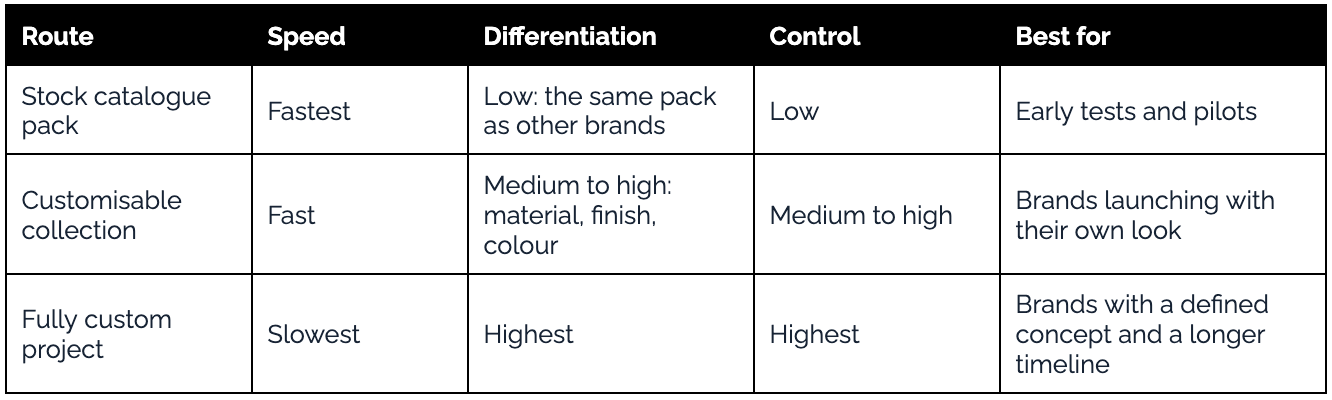
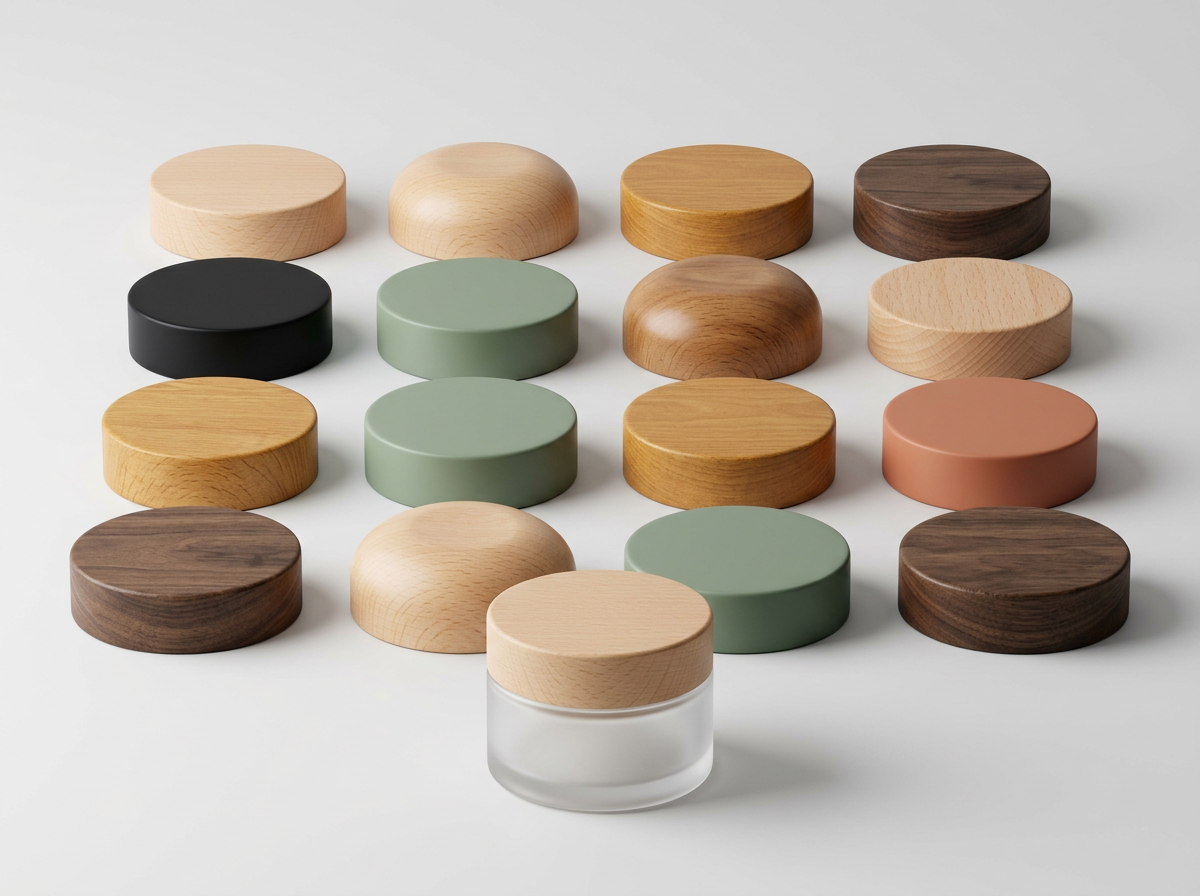
The middle route is how mPackting's collections work. They are ready-to-use platforms, and the closures are customisable by assembly system, wood type, shape, finish, colour and varnish. Each collection pairs a closure with several glass options. mPackting does not make the glass: it comes from specialist glassmakers such as Estal, while mPackting designs and customises the closures and finishes. When a project needs more than a collection offers, the custom solutions service develops the packaging together from scratch.
Sustainable options that also feel premium
Premium and sustainable are not opposite goals. The same material qualities often serve both. The renewable materials mPackting works with show how.
FSC-certified wood. Warm, tactile and visibly natural, from a certified source. It suits caps, collars and closures that are handled every day.
Glass. Weight, clarity and a clean surface signal quality, and glass is widely recycled. Frosted glass also protects light-sensitive formulas.
Bio-based composite (mBlack™). A composite of biochar and biopolymer, shaped by standard injection moulding, with a deep black, precise finish.
Glue-free assembly. Mechanical inserts keep a closure secure without adhesive and let the parts separate at end of life, as in mPackting's assembly systems.
What premium means in packaging
Premium is a set of sensory signals, and most of them come from materials and details, not from size or cost.
Weight in the hand. A solid closure and a well-balanced jar feel considered.
Honest material. Visible grain or a precisely moulded surface reads as authentic.
Closure feel. A clean thread and a defined stop suggest precision before the first use.
Finish and colour. Consistency across batches matters as much as the shade itself.
Coherence across the range. The same closure language on every product builds a recognisable brand.
A new brand gains more from two or three well-chosen details repeated across the range than from many effects on a single product. For high-end ranges, the page on luxury cosmetic packaging manufacturing goes further.
How to evaluate a cosmetic packaging manufacturer
Before choosing a cosmetic packaging manufacturer, check six points.
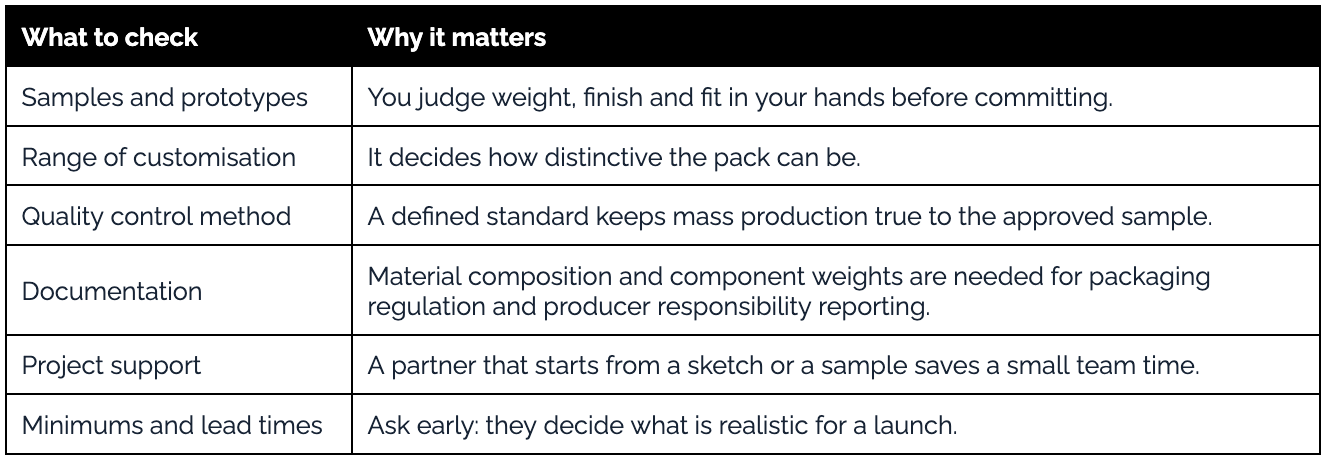
The documentation point matters more every year. The EU packaging regulation requires all packaging to be recyclable by 1 January 2030, and the mPackting guide to the PPWR in cosmetic packaging explains the timeline.
Red flags
Vague answers on materials and certifications. A partner that cannot say what a pack is made of cannot support a claim.
Generic environmental claims. Since 27 September 2026, Directive (EU) 2024/825 prohibits generic environmental claims without proof, and terms such as "green" and "ecological" are among the examples.
No samples before bulk. Approving a design from a render alone is risky.
Unclear minimums and lead times. Surprises here can break a launch plan.
Mixed materials sold as sustainable. A pack that cannot be separated cannot be recycled as one stream.
What working with mPackting looks like
The hand-in-hand process starts from an idea, a sketch, a technical drawing or a physical sample. The team works side by side with the brand: you guide the aesthetic and functional choices, and digital technical drawings turn them into feasible solutions.
Prototypes follow, made with additive technologies such as 3D printing or with traditional wood processing, so solutions are validated before production. The in-house additive hub and the CNC area, described on the prototyping page, work with polymers, wood and cork.
Engineering and optimisation then make the pack easier to produce, economically sustainable and functional. A larger batch of samples simulates industrial production; quality standards are set with AQL tolerances, a quality control method, and a range board that guides production once approved, so mass production reflects the prototype. After production starts, the team keeps monitoring quality and offers technical assistance.
Frequently asked questions
What does a cosmetic packaging manufacturer do?
A cosmetic packaging manufacturer designs, engineers and produces the components of a pack, such as closures, caps and structural parts, and adapts them to a brand's brief. It does more than resell catalogue items.
What is the difference between a manufacturer and a supplier?
A supplier or distributor sells packaging that already exists, usually from a catalogue. A manufacturer makes the packaging, so it can customise materials, finishes and details, and it controls quality from prototype to production.
What is MOQ in cosmetic packaging?
MOQ stands for minimum order quantity: the smallest quantity a manufacturer will produce for one order or one design. It varies with the material, the process and the level of customisation, so ask for it early in the conversation.
Can an indie brand have premium and sustainable packaging?
Yes. Premium comes from materials and details such as weight, grain, finish and the feel of the closure, and several sustainable materials deliver exactly that. Starting from a customisable collection keeps the project realistic for a new brand.
How do I choose a cosmetic packaging manufacturer?
Ask for samples, check how far the product can be customised, confirm the quality method and the documentation provided, and ask about minimums and lead times. Prefer a partner that works from your sketch and stays involved through production.
Where to start
The right cosmetic packaging manufacturer for an indie brand is the one that starts from your idea, shows you samples, documents its materials and stays involved after the first order. Everything else, including premium feel and sustainability, follows from those four habits.
A new brand should not have to coordinate several suppliers. mPackting takes care of your primary packaging from A to Z, guiding you hand in hand from design to prototyping and production. Our collections are customisable, ready-to-use platforms that give a new brand a distinctive, premium and sustainable look to stand out in a competitive market. Contact us to find the collection that fits your launch.
