

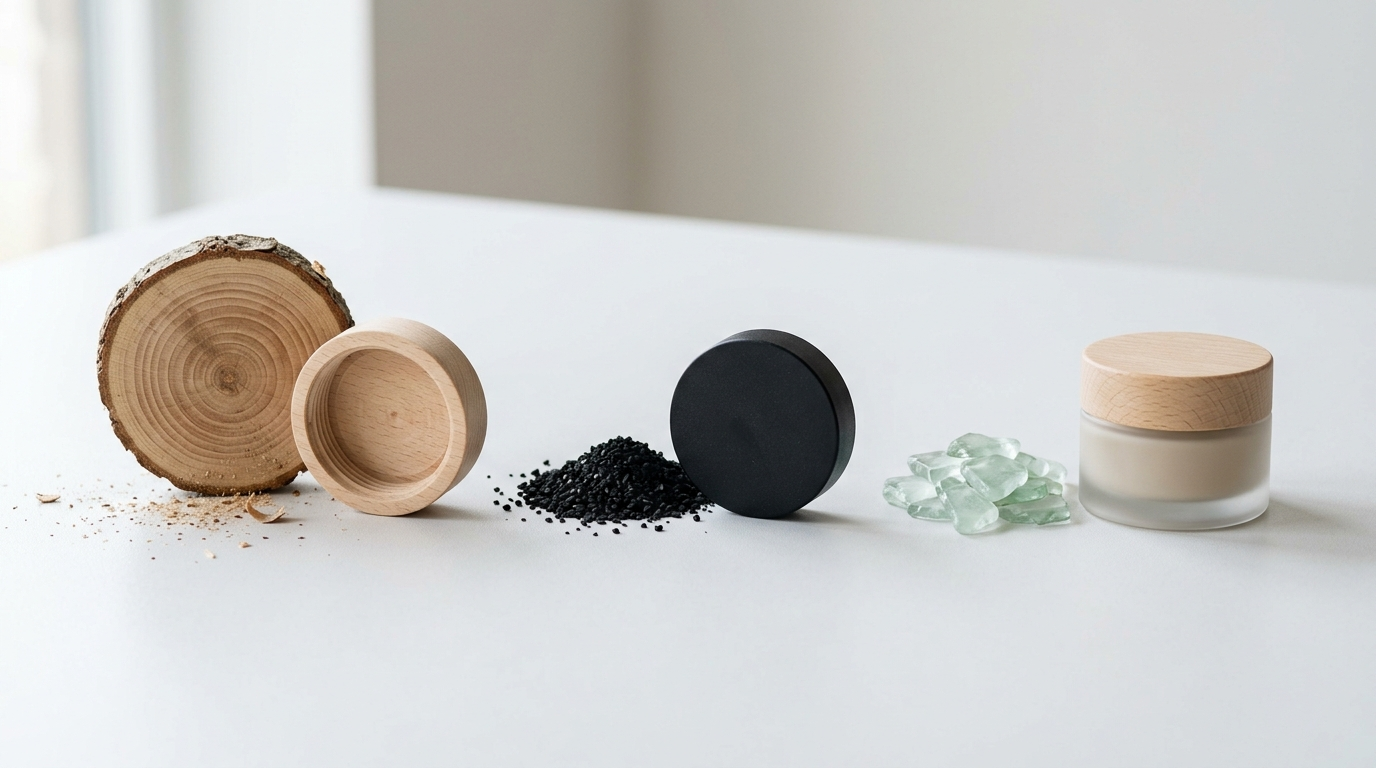
Ecological packaging materials are chosen to reduce the environmental impact of a pack across its life: renewable, recycled or certified in origin, and designed to be reused, recycled or returned to nature. For beauty brands, the benefits are practical: less waste, readiness for regulation, stronger appeal with customers and a better product experience, as long as each claim can be proved.
What ecological packaging materials are, and what the term should mean
Ecological packaging materials is a common search term and a useful shorthand. In practice it covers renewable materials such as FSC-certified wood, recyclable ones such as glass and aluminum, recycled inputs such as PCR plastic, and bio-based composites.
The word itself needs care. Since 27 September 2026, Directive (EU) 2024/825 prohibits generic environmental claims made without proof, and terms such as "green", "ecological" and "biodegradable" are among the examples. As a topic, ecological packaging materials is fine to discuss. As a claim on a pack or a website, it should give way to something specific, such as "FSC-certified beech wood closure".
Why beauty brands are looking at them now
Regulation and customers are pushing in the same direction. The EU packaging regulation requires all packaging to be recyclable by 1 January 2030 and the mPackting article on the PPWR in cosmetic packaging explains the timeline.
Customers show interest, with limits. In McKinsey's global survey work on sustainable packaging, at least 40% of consumers in every country covered in 2023 said they would pay more, and more than 70% in Mexico, Brazil, India and China. The share willing to pay a lot more has stayed small across three survey rounds. Customers like sustainable packaging, but few expect to pay a lot extra for it.
At the same time, producer responsibility schemes charge fees that rise as recyclability falls, which turns a material choice into a recurring cost and not a one-off decision.
Benefit 1: less waste over the life of the pack
Materials that are renewable, recycled or easy to recover reduce the amount of virgin raw material used and the volume of packaging that ends in landfill. The effect grows when the design helps: fewer components, one material per part, and closures that come apart. A material that is sustainable on paper but glued into an inseparable assembly loses most of the benefit. The assembly systems page shows how glue-free inserts address this, and the guide to recyclable skincare packaging covers the recycling side.
Benefit 2: readiness for regulation and producer responsibility fees
Packaging designed for recycling avoids a forced redesign later. It also tends to cost less to place on the market, because producer responsibility fees are increasingly modulated by recyclability: packaging that is easier to recycle pays less, and national schemes already apply this logic. The material choice therefore shows up in a recurring cost line, not only in the unit price of the pack.
Benefit 3: stronger appeal with customers
Customers read packaging before they read a label. A pack made of visible, recognisable materials, such as wood with its grain or glass with its weight, communicates care without a slogan. The appeal is strongest when it comes with clarity: what the pack is made of, and what to do with it afterwards.
The survey data above also sets the limit. Sustainable packaging earns interest, not unlimited tolerance on price. The strongest position is a pack that looks premium, performs well and does not ask the customer to pay a large premium for the material.
Benefit 4: a better product experience
Many lower-impact materials are also pleasant to handle. Wood brings warmth and grain, glass brings weight, and a bio-based composite such as mBlack™, a composite of biochar and biopolymer shaped by standard injection moulding, gives a deep black, precise surface. These qualities are sensory signals of quality, and they work on every use of the product, not only at the moment of purchase.
Benefit 5: certified, traceable sourcing
FSC certification indicates that wood comes from responsibly managed forests. A documented supply chain makes claims easier to support and reporting easier to complete. A brand that knows where its closure comes from can answer a retailer's question or a customer's question with facts, which matters more now that generic claims are restricted.
Which materials deliver which benefit
The table links the main materials to their strongest benefit and their main limit. The mPackting materials page and the page on renewable materials give more detail.
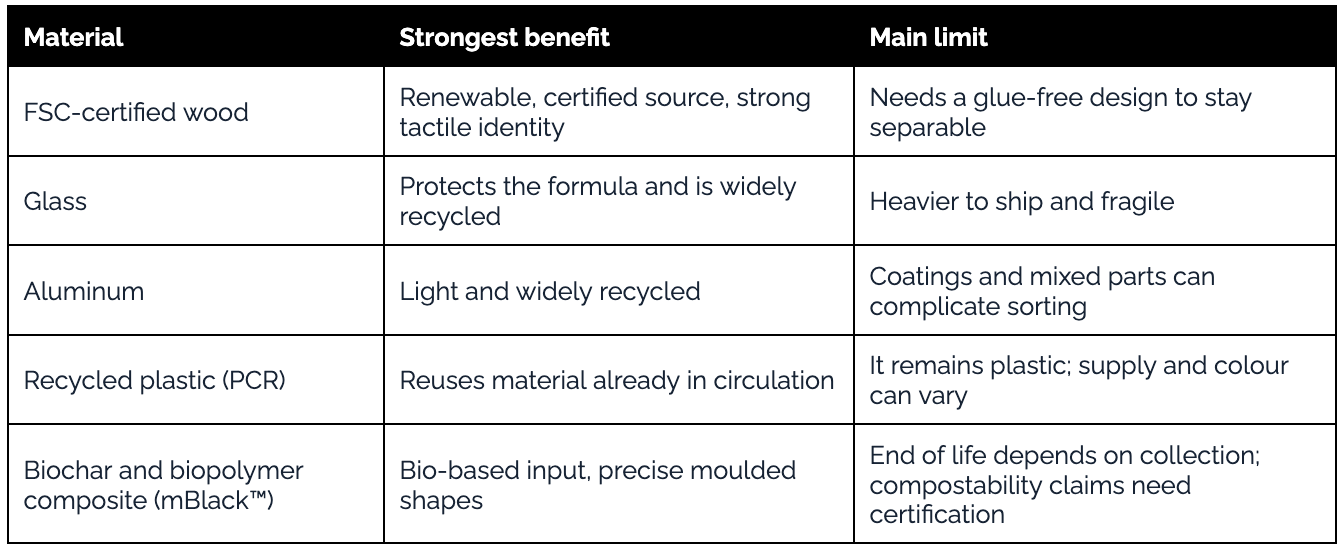
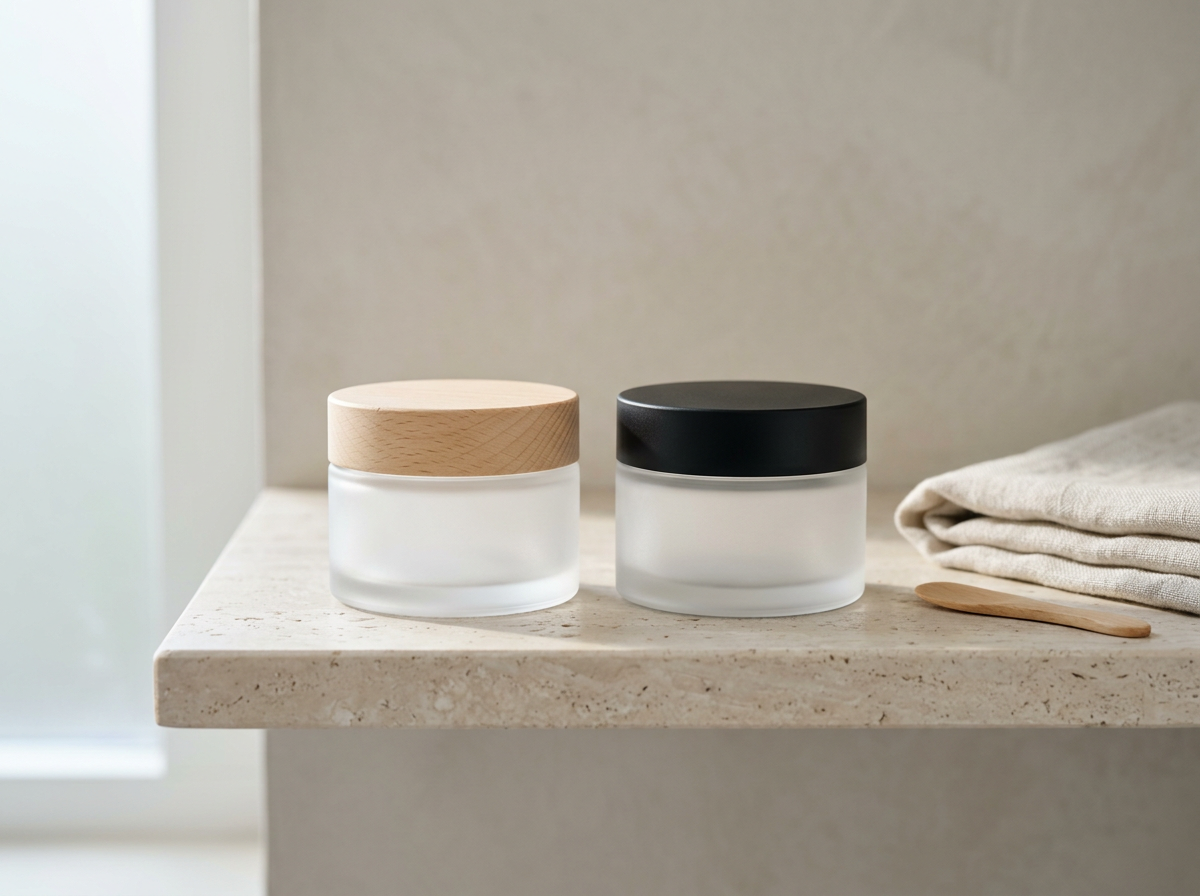
The table also shows why combinations are common. A glass body with a wood closure joins the protection of one material to the tactile quality of another, and both can be separated at end of life when the assembly is glue-free. The benefit comes from the pairing and the joint, not from a single material alone.
The limits: cost, performance and claims
Cost. Advanced materials can cost more. Fewer components, simpler assembly and lower producer responsibility fees can offset part of the difference, but the balance depends on the material and the volume.
Performance. A pack still has to protect the formula. Test the formula in the final pack before the first production order.
End of life. A material is only as good as the route it follows after use. Check that recycling, take-back or composting exists in the markets where you sell.
Claims. Describe materials precisely and keep the documents that prove each statement.
How to capture the benefits: a checklist
Start from the formula. Write down what the formula needs before choosing a material.
Choose materials with a documented source. Certifications, composition and weights should be available on request.
Design for separation. Fewer components, one material per part, no glue.
Check the end-of-life route. Make sure the pack has somewhere to go in each market.
Replace generic words with facts. Say what the pack is made of and where it goes.
Keep the paperwork. Certificates, test results and supplier documents support every claim.
A brand that launches now can apply the checklist before tooling is cut, which is the moment when changes cost least. For an existing range, starting with one product and improving its weakest link gives real data before the change is extended.
Frequently asked questions
What are ecological packaging materials?
The term covers materials chosen to reduce the environmental impact of a pack: renewable ones such as FSC-certified wood, recyclable ones such as glass and aluminum, recycled inputs such as PCR plastic, and bio-based composites. Each has different strengths and limits.
What are the benefits of ecological packaging in the beauty industry?
The main benefits are less waste over the life of the pack, readiness for packaging regulation and producer responsibility fees, stronger appeal with customers, a better tactile product experience and more traceable sourcing.
Do customers pay more for ecological packaging?
Many say they would, but few expect to pay a lot more. Surveys show that a large share of consumers would pay a little extra, while the share willing to pay a lot more stays small, so affordability still matters.
Is ecological packaging more expensive?
It can be, because advanced materials often cost more. Fewer components, simpler assembly and lower producer responsibility fees can offset part of the difference, and the balance depends on the material and the volume.
Can I call my packaging ecological?
Not as a generic claim. In the EU, terms such as ecological, green and biodegradable are examples of generic environmental claims that need proof. Describe the material and the certification instead, for example an FSC-certified beech wood closure.
Where to start
The benefits of ecological packaging materials are real, and they depend on details: which material, how it is assembled, where it ends up and how it is described. A brand that gets those four right gains on waste, regulation, appeal and product experience at the same time.
Ready to choose materials you can describe precisely? mPackting develops primary packaging in FSC-certified wood and bio-based composites, with customisable collections as ready-to-use platforms for new brands.
Contact us to find the solution that fits your products.
