

How does EPR impact skincare businesses?

EPR skincare packaging rules make the brand that puts a packaged product on the market responsible for what happens to that packaging after use. In practice, extended producer responsibility means registering, reporting packaging data and paying fees, and those fees increasingly depend on how recyclable the packaging is.
What extended producer responsibility means for skincare
Extended producer responsibility, or EPR, moves the cost of collecting, sorting and recycling packaging from public budgets to the businesses that place packaged goods on the market. For a skincare brand, every jar, bottle, closure, carton and shipping box is packaging that counts.
This article covers the cost and compliance side. If you want the full picture of the recyclability requirements phasing in under the new EU regulation, the mPackting guide to the PPWR in cosmetic packaging goes through them.
Who counts as the producer?
Under the EU Packaging and Packaging Waste Regulation, a business that first makes packaging available in a Member State is treated as the producer for EPR purposes. For skincare, that is usually the brand owner, an importer, or an online seller shipping directly to consumers.
The obligation sits with whoever first puts the filled pack on that market, not automatically with the packaging supplier. Your contract with the packaging manufacturer should state who provides the data you will need to report, such as weights, materials and recyclability documentation.
What EPR asks of a skincare brand: register, report, pay
The core EPR skincare packaging duties are the same in most schemes, even though the details change from country to country.
Register. Producers enrol in the national producer register or with a producer responsibility organisation, often called a PRO, before placing packaging on the market.
Report. Producers declare the type, weight and material of the packaging they place on the market, usually every year.
Pay. Producers pay fees that fund collection, sorting and recycling. The fee depends on how much packaging you sell and what it is made of.
For a new brand with small volumes, EPR skincare packaging fees are often modest, because they are driven by weight. The heavier load is administrative: several countries mean several registrations and several reports. Collecting packaging data once, at the design stage and in a single sheet, saves most of that work later.
Unregistered producers can be barred from making packaging available. In the EU, the regulation says producers must not make packaging available in a Member State unless they, or their authorised representative, are registered there.
How fees work and what eco-modulation changes
EPR fees are rarely a flat rate. They are calculated from the weight of packaging, the material and, more and more, its recyclability. This adjustment is called eco-modulation: packaging that is easier to recycle pays less, and packaging that is harder to recycle pays more.
The PPWR requires fees to be modulated by recyclability performance grade, and Member States can also add criteria such as recycled content. The harmonised rules follow later acts of the Commission, so national schemes keep applying their own modulation in the meantime.
For a brand, the consequence is practical: packaging decisions made at design stage now have a direct line to a yearly cost.
EPR in the EU: national registers, one set of principles
Registration is national, not European. Each Member State runs its own producer register, and a producer that sells in several countries registers and pays in each of them. A producer that sells across a border directly to end users, and has no establishment in that country, must appoint an authorised representative for EPR there.
Several countries already had mature schemes. CITEO in France and CONAI in Italy already model fees by material and recyclability, and Germany registers producers in the LUCID register. The PPWR harmonises who the producer is, how registration and reporting work, and the criteria for modulating fees, but it does not replace these national schemes.
If you sell online to customers in other EU countries, check each market separately before your first order ships.
Beyond the EU: the UK and the US
In the UK, packaging EPR applies to businesses above both a £1 million turnover and a 25 tonne packaging threshold. Large producers, from £2 million and 50 tonnes, pay disposal fees, and from 2026 those fees are modulated by recyclability, as the ERP guide to UK packaging EPR outlines.
In the US, there is no federal scheme. Seven states have enacted packaging EPR laws: California, Colorado, Maine, Maryland, Minnesota, Oregon and Washington. Each has its own timeline, so a brand selling nationwide faces several programs at once.
Packaging choices that raise or lower the cost
Fees follow design. The table shows how common choices tend to affect EPR skincare packaging costs. The effect is directional: exact amounts depend on each national scheme.
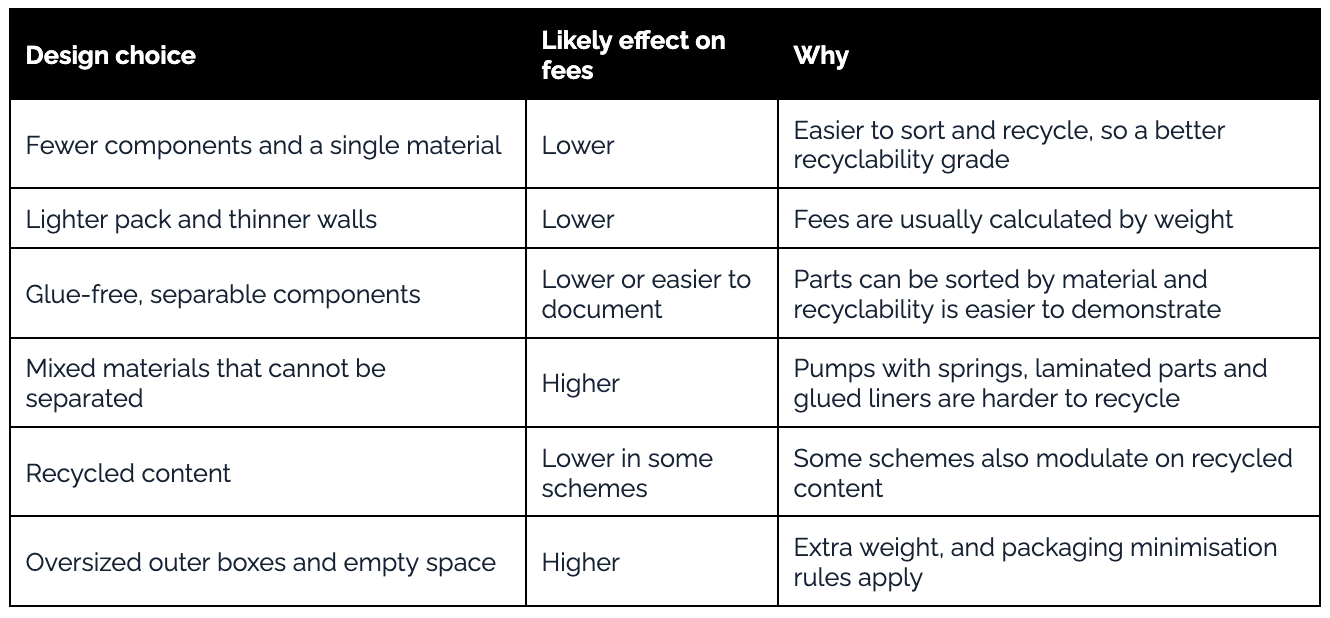
This is where closures matter. A cap with a glued insert and a cap built from separable parts can look identical on a shelf but behave differently in a recycling stream. mPackting's assembly systems are built around glue-free inserts and a simplified material structure.
What to do now: a checklist for skincare brands
Map your markets. List every country where you sell, including online orders, and check the EPR rules of each one.
Confirm your role. Work out whether you are the producer, the importer or the seller in each market.
Build a packaging data sheet. For every SKU, record each component, its material and its weight.
Ask suppliers for documents. Request material composition and recyclability evidence from every packaging supplier.
Budget the fees. Ask the relevant PRO for its fee schedule and include it in your cost per unit.
Design with the fee in mind. Simplify components and materials before a new product reaches production.
This article is general information, not legal advice. Obligations depend on the countries where you sell and on your role in the supply chain, so confirm them with a specialised consultant or the relevant producer responsibility organisation.
Frequently asked questions
What is extended producer responsibility in skincare?
It is a rule that makes the business placing packaged skincare on a market responsible for the cost of collecting and recycling that packaging after use. In practice it means registering, reporting packaging data and paying fees.
Does EPR apply to small and indie skincare brands?
It can. Thresholds and simplified rules differ by country, and in some markets very small producers have lighter duties. Check the rules of each country where you sell before your first shipment.
How much does EPR cost?
There is no single figure. Fees depend on the country, the weight of packaging, the material and, increasingly, how recyclable the pack is. Ask the relevant producer responsibility organisation for its current fee schedule.
Which packaging pays lower EPR fees?
Lighter packs with fewer components and better recyclability tend to pay less, because fees are modulated by weight, material and recyclability performance. Exact rules depend on each national scheme.
Does EPR apply when I sell online to other countries?
Often yes. In the EU, a producer that sells across a border directly to end users must appoint an authorised representative for extended producer responsibility in each Member State where it first makes packaging available.
Where to start
EPR turns packaging design into a recurring cost line. The cheapest moment to reduce that line is before tooling is cut: fewer components, one material per part and closures that come apart.
If you are planning a launch or a redesign, talk to us early. mPackting develops primary packaging with recyclability and separability in mind from the first sketch. Contact us to start the conversation.
