

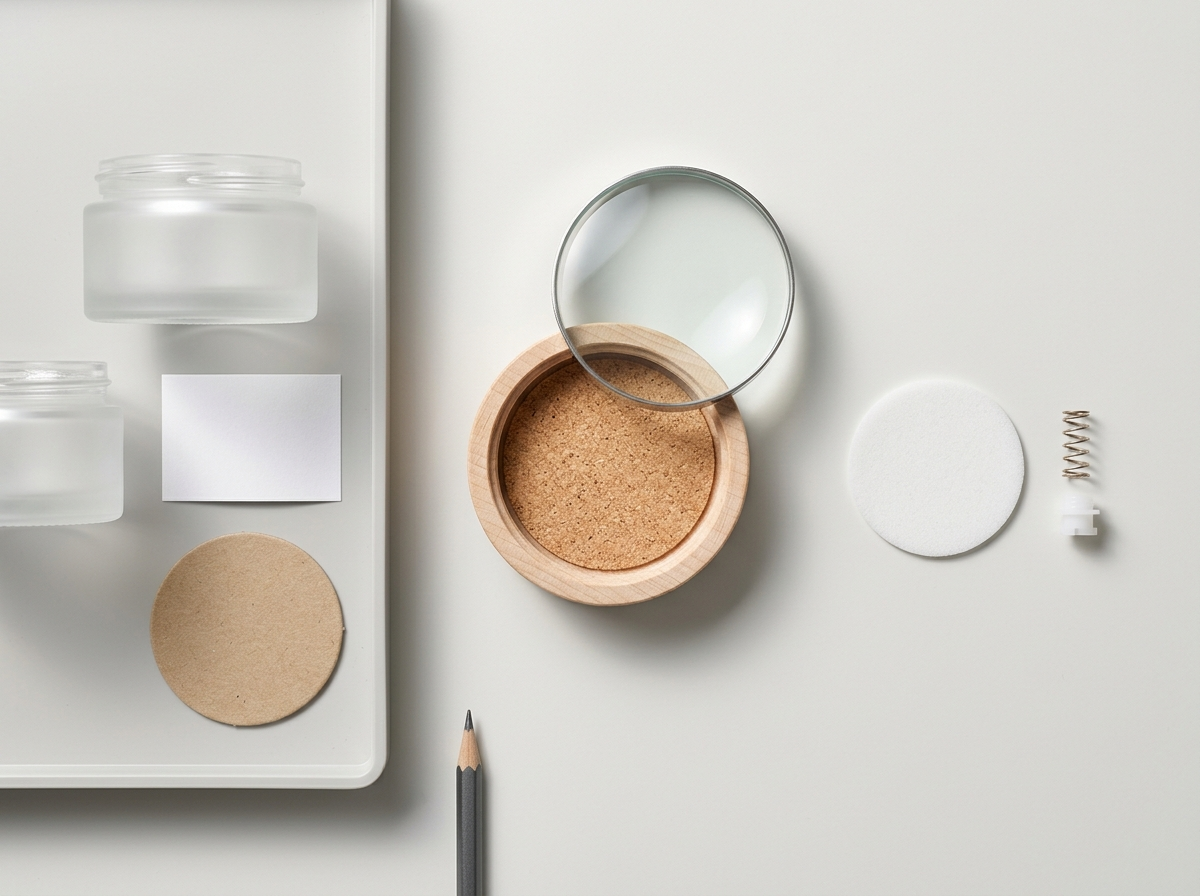
Plastic-free cosmetic packaging contains no synthetic polymer in any component: not in the container, the closure, the liner or seal, the coating, the ink or the adhesive. Glass, aluminum, certified wood and uncoated paper can get there, but only if every part of the pack is checked, because plastic often hides in the details.
What plastic-free cosmetic packaging really means
The phrase sounds simple and is easy to get wrong. A glass jar is plastic-free as a material. A glass jar with a plastic liner, a coated lid and a pump with a plastic spring is not a plastic-free pack.
For a claim to hold, it has to apply to the whole pack as it reaches the customer. That is the standard used in this article.
Why brands are looking at plastic-free alternatives now
Many customers associate plastic with waste, which makes plastic-free an attractive promise for a brand. A new brand can build its packaging around that promise from the first order, while an established brand has to retrofit existing ranges, which is slower and more expensive.
It is not a legal requirement. The EU packaging regulation does not ban plastic: it requires all packaging to be recyclable by 1 January 2030. Plastic packaging designed for recycling can stay on the market, so plastic-free is a brand choice. The mPackting article on the PPWR in cosmetic packaging explains what the regulation does require.
Where plastic hides in a "plastic-free" pack
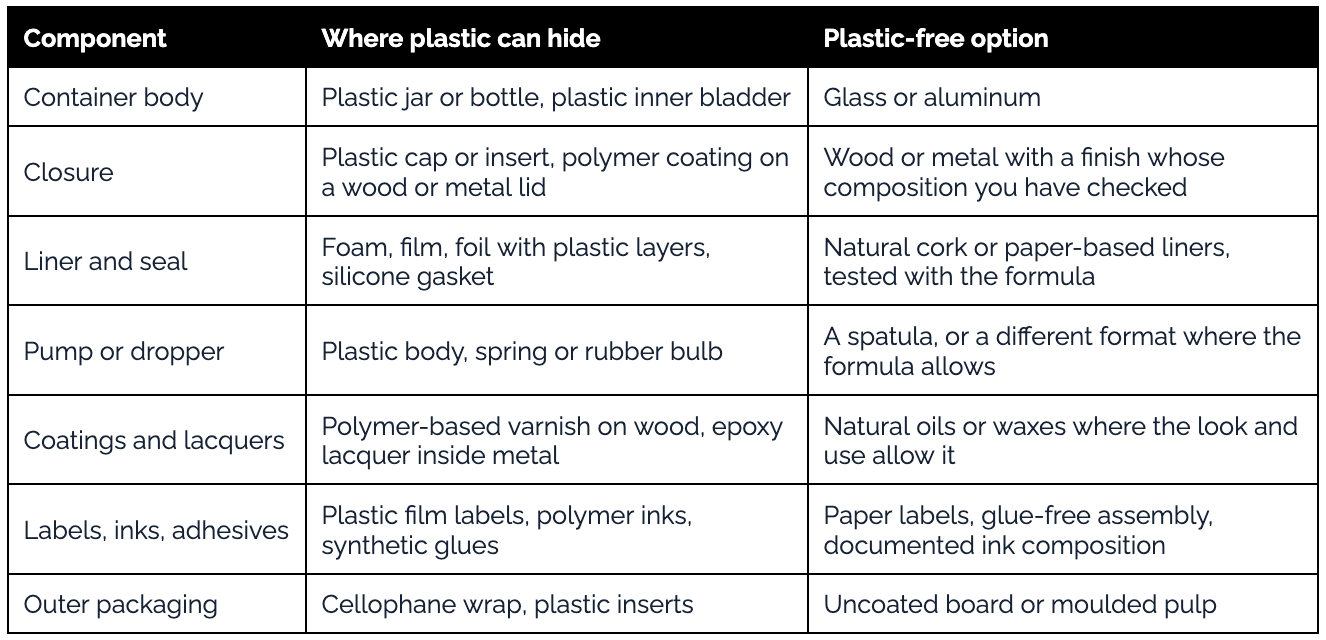
Most packs that look plastic-free contain plastic in at least one small part. The table lists the usual places.
Plastic-free alternatives to consider
Glass. Inert, protective and widely recycled, with a premium weight in the hand. The closure and the liner decide whether the whole pack is plastic-free.
Aluminum and other metals. Light, strong and widely recycled. Internal coatings, such as lacquer or epoxy, can be polymer-based, so ask what protects the metal from the formula.
FSC-certified wood. Renewable, from a certified source, and tactile. The finish decides the outcome, and glue-free assembly keeps the parts separable.
Paper and board. Suited to dry products and outer packaging. Coatings and liners often contain plastic, so only uncoated board or uncoated pulp qualifies.
Cork as a component. Cork works as an inner component, such as a capsule or a liner, not as a whole closure.
The mPackting materials page and the page on renewable materials describe the materials the company works with.
Bio-based is not the same as plastic-free
Bio-based plastics come from biological resources instead of fossil ones, but they are still polymers, and the European Commission notes that they are not necessarily biodegradable or compostable. Bio-based answers the question of where a material comes from. Plastic-free answers the question of what it is.
A bio-based composite such as mBlack™, made of biochar and a biopolymer, is bio-based but not plastic-free, because it contains a polymer. It is shaped by standard injection moulding and gives a deep black, precise finish, which makes it a good option when a brand wants a bio-based input and a moulded shape. It is not an option for a plastic-free claim.
Reduce before you replace
Replacing a material is the second step. The first is asking whether the pack is needed at all. A refill keeps a durable case in use for years, as the article on refillable packaging explains. Solid formats, such as balms and bars, need little packaging. Fewer components also mean fewer places for plastic to hide.
Trade-offs: weight, protection and cost
Weight. Glass and metal weigh more than most plastics, which affects transport.
Protection. Plastics are light and impact-resistant. Any replacement still has to protect the formula, so test it in the final pack.
Cost. Alternative materials can cost more. Fewer components and simpler assembly can offset part of the difference.
Impact. Plastic-free is not automatically the lowest-impact choice. Weight, reuse and the recycling route all count, so compare the whole life of the pack.
How to make a plastic-free claim you can defend
Since September 2026, Directive (EU) 2024/825 prohibits generic environmental claims without proof. A plastic-free claim is specific, which is good, but it has to be true for the whole pack. If only part of it qualifies, name that part.
List every component. Container, closure, liner, pump, coating, ink, label and adhesive.
Get the composition. Ask each supplier for a written declaration of what each part is made of, including coatings and glues.
Test with the formula. Check that the plastic-free parts protect and seal the product.
Claim precisely. Write "plastic-free closure" if only the closure qualifies, and "plastic-free packaging" only when everything does.
Keep the paperwork. Declarations, certificates and test results support the claim.
A worked example: plastic-free cosmetic packaging for a cream
Take a face cream in a jar and check each component in turn. The glass body qualifies as a material. The wood lid qualifies if its finish has been checked and no polymer coating or hidden insert is involved. The inner liner qualifies if it is natural cork or paper-based and tested with the formula. The label qualifies if it is paper with a documented adhesive, and the outer carton qualifies if it is uncoated board.
Only when every line of that list is verified can the whole jar be called plastic-free. If one line fails, for example because the liner is a foam disc, the honest wording changes to something narrower, such as a glass jar with a wood lid. That is still a good pack, and describing it accurately is what protects the brand.
Frequently asked questions
What is plastic-free cosmetic packaging?
It is packaging with no synthetic polymer in any component: container, closure, liner or seal, coating, ink and adhesive. A single plastic part, such as a liner or a coating, is enough to make a pack not plastic-free.
What can replace plastic in cosmetic packaging?
Glass, aluminum and other metals, FSC-certified wood and uncoated paper or board are the main options. Cork works as an inner component. Each replaces plastic in some parts of a pack and brings its own limits.
Is bioplastic plastic-free?
No. Bio-based plastics are made from biological resources but are still polymers, and the European Commission notes they are not necessarily biodegradable or compostable. A bio-based composite that contains a biopolymer is bio-based, not plastic-free.
Is plastic-free packaging always better for the environment?
Not automatically. Weight, protection of the formula, reuse and the recycling route all count. A heavier pack that is not reused or recycled may not have a lower impact than a lighter plastic one, so the whole life of the pack should be compared.
Can I label my packaging plastic-free?
Only if every component qualifies and you can prove it. In the EU, generic or unsupported environmental claims are restricted. If only part of the pack is plastic-free, name that part, for example a plastic-free closure, and keep the evidence.
Where to start
Plastic-free cosmetic packaging is achievable, and it is a matter of detail: every component, every coating and every seal. A brand that lists its parts, asks for compositions and describes the result precisely can make a claim that holds.
Want to explore plastic-free options for your products? mPackting develops primary packaging in FSC-certified wood with glue-free assembly systems, and works with you component by component. Contact us to start the conversation.
