

Simple ways to make your packaging more sustainable for brands that are about to launch
How to make packaging more sustainable at launch comes down to four decisions: what the pack has to do, how few parts it needs, which materials suit your formula, and how it comes apart at the end of its life. Choices made at launch are cheaper to get right than changes made after the first production run.
How to make packaging more sustainable when you are launching a brand
A new brand has one real advantage over an established one: no legacy packaging to replace. Every decision is still open, and the cheapest moment to improve a pack is before the first tool is cut, not after the first batch is on the shelf.
That advantage comes with pressure. A launch is a chance to stand out without complicating the project. The seven steps below are ordered the way a small team can work through them.
Step 1 · Define what your packaging has to do
Before choosing a material, write down three things: what the formula needs, how the product will be used, and what the pack has to say about the brand on a shelf or a screen. A light-sensitive serum needs protection first. A solid balm needs a closure that holds. A fragrance may need weight and a tactile feel.
This short brief prevents the most common mistake in a first launch: picking a beautiful container and discovering later that it does not protect the formula or survive shipping. A sustainable material cannot make up for a pack that does not do its job: rejected batches, damaged goods, and replacements add the waste back.
Step 2 · Start with less
The most sustainable component is the one you never make. Count every part in your planned pack: container, closure, liner, insert, label, outer box. For each one, ask whether the product still works without it.
Merge a liner and a closure into one part where function allows
Skip the outer box when the primary pack is attractive enough to sell on its own
Ship in recycled cardboard sized to the product, not in a standard carton
Fewer parts also mean fewer suppliers, fewer minimum orders, and fewer things that can go wrong, which matters most for a small team.
Step 3 · Pick materials that fit your formula and your look
Each material gives a different look and carries a different limit. The table compares the options new brands ask about most. The mPackting materials page describes the range in more detail, and the guide to recyclable skincare packaging covers the recycling side.
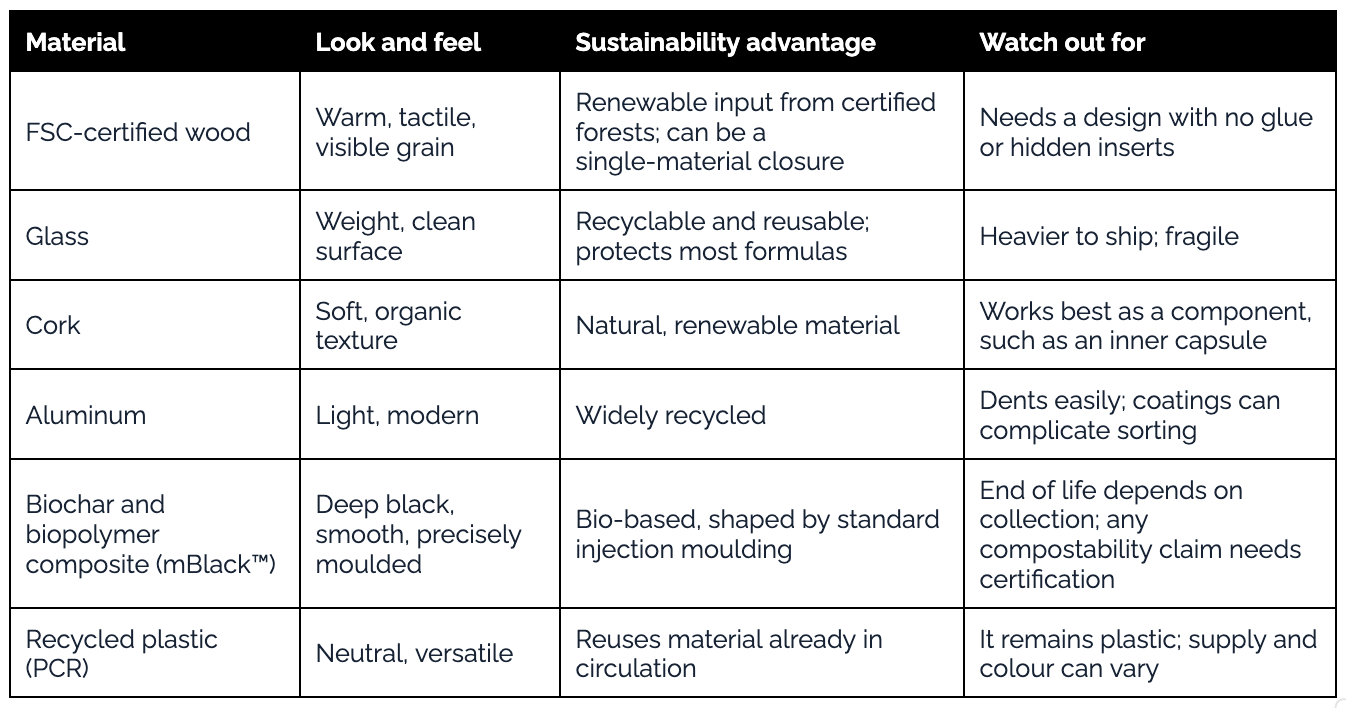
No single material wins. The right one protects your formula, matches your brand and has a realistic end-of-life route in the markets where you sell.
Step 4 · Choose closures built to separate
Closures are where sustainable intentions most often fail. A glass jar with a glued-in liner or a hidden plastic insert cannot be recycled as one stream, however good each material is on its own. Look for closures whose components fit mechanically, so they can be separated by hand.
mPackting's assembly systems follow this principle. Caps and closures use glue-free inserts that provide the friction a secure closure needs, so the formula stays protected. Depending on the system, the pack stays mono-material or its components separate cleanly, so each part can follow the right disposal route.
Step 5 · Plan refill from day one
You do not need to launch a refill range to plan for one. A case built to be kept, with a closure that survives repeated opening, leaves the option open. A brand that launches with a durable case can add a refill later without redesigning its hero product, while a case that scratches or loosens after a few uses closes that door. The article on refillable packaging looks at how these systems work.
Step 6 · Start from a ready-to-use platform, then customise
Developing fully custom packaging from a blank page takes time and tooling that a new brand rarely has. A ready-to-use platform offers a different route: a structure that is already engineered, which you make your own through material, finish and detail.
This is how mPackting's collections work. They are ready-to-use platforms, and every piece in the portfolio can be customised, so a new brand can launch with a look of its own on a structure that already works. When a project needs more, the packaging can be developed together from scratch through the custom solutions service.
Step 7 · Check regulation and claims before launch
Regulation (EU) 2025/40, the Packaging and Packaging Waste Regulation, has applied since 12 August 2026 and requires all packaging to be recyclable by 1 January 2030. Designing for recyclability at launch avoids a forced redesign later. The mPackting explainer on the PPWR in cosmetic packaging covers what changes for brands.
Claims need the same care. Since 27 September 2026, Directive (EU) 2024/825 prohibits generic environmental claims made without proof of recognised excellent environmental performance, and terms such as "green", "ecological" and "biodegradable" are among the examples. For a new brand, the safest copy states what the pack is made of: "FSC-certified beech wood cap" says more, and risks less, than "eco-friendly packaging".
Quick reference: what to do first
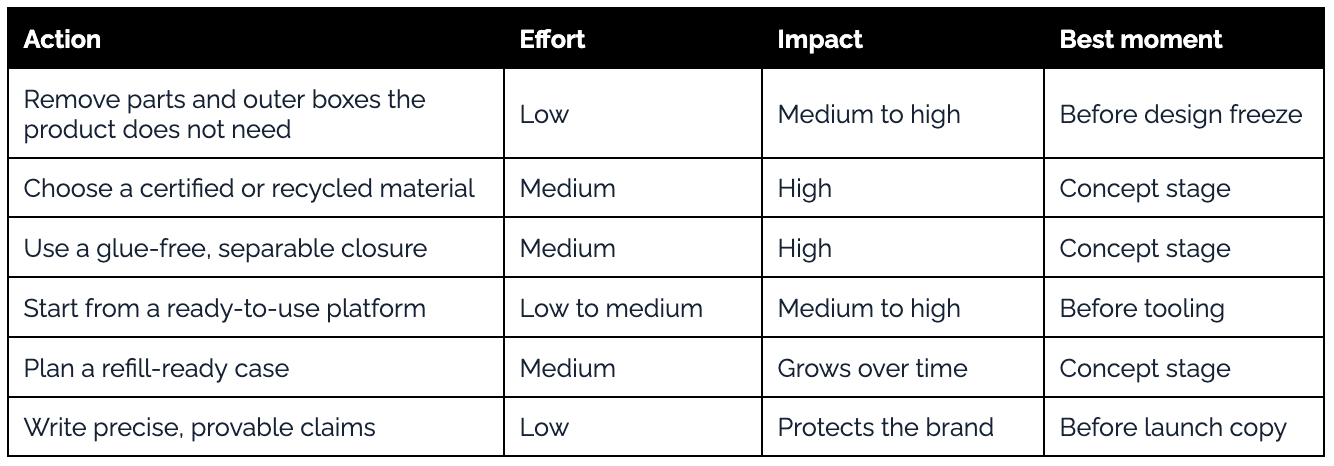
The table orders the seven steps by effort and impact. The ratings are our own qualitative assessment, not measured values.
Common obstacles for new brands
Cost. Biodegradable and advanced materials are often more costly, which limits adoption. Fewer parts and a ready-to-use platform keep a first budget under control.
Minimums and lead times. New brands usually work with small first runs. Ask every supplier about minimum quantities and lead times before you commit to a design, because both decide what is realistic.
Performance. A sustainable pack still has to protect the formula. Test the formula in the final pack, including stability and the seal of the closure, before the first production order.
Frequently asked questions
How to make packaging more sustainable for a new cosmetic brand?
Start with fewer components, choose materials that have a real end-of-life route, use closures that separate and write claims you can prove. Doing this at the design stage is simpler than changing a pack after launch.
What is the easiest first step for a new brand?
Remove what the product does not need, such as liners, inserts and outer boxes. It costs little, lowers material use and simplifies production.
Is sustainable packaging more expensive?
It can be, because advanced materials often cost more. A brief with fewer parts and a ready-to-use platform keep the budget manageable, and actual figures depend on the supplier and the volume.
Which material is the most sustainable for cosmetics?
No single material wins. Certified wood, glass, aluminum, recycled plastic, and bio-based composites suit different formulas and looks. The right choice protects the product and has a realistic end-of-life route where you sell.
Do I need a fully custom design to stand out?
No. A customisable ready-to-use platform lets a new brand choose its own materials, finishes and details on a structure that is already engineered. A fully custom project can follow as the brand grows.
Where to start
You do not need to do everything at once. Knowing how to make packaging more sustainable comes down to a short sequence: write the brief, remove what you do not need, choose one material and one closure you can defend, and write claims you can prove. Each decision made at launch is one you will not have to redo.
A new brand should not have to coordinate several suppliers. mPackting takes care of your primary packaging from A to Z, guiding you hand in hand from design to prototyping and production. Our collections are customisable, ready-to-use platforms that give a new brand a distinctive, sustainable look to stand out in a competitive market. Contact us to find the collection that fits your launch.
