

Innovative cosmetic packaging design that shapes the beauty industry
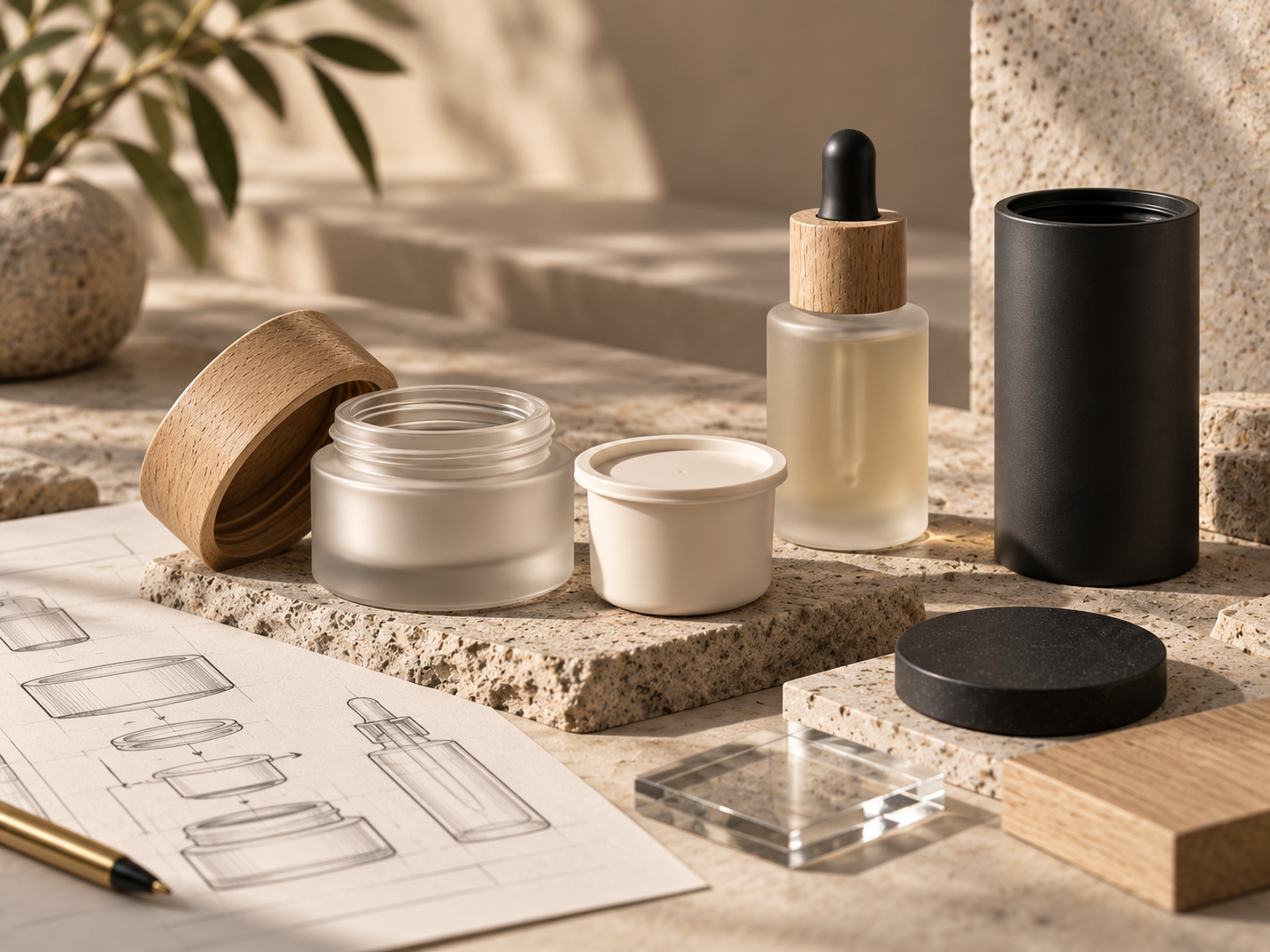
Today, cosmetic packaging design is judged as much on function as on looks: how well it protects a formula, how easily it refills, and how little it wastes across its lifecycle. The brands setting the pace treat packaging as part of product development, not a finishing touch applied after the formula is locked.
What cosmetic packaging design means today
Cosmetic packaging design covers every decision that shapes how a container looks, performs and is produced: material, closure mechanism, dosing system, finish, and how the piece behaves across its full lifecycle, not just on the shelf.
That definition has shifted in the past few years. Packaging is no longer judged mainly on how it looks in a product photo. It is judged on how it performs under real conditions, protecting a light-sensitive formula, surviving repeated refills, or breaking down cleanly at end of life.
This is why cosmetic packaging design increasingly sits inside product development rather than after it. A closure engineered alongside the formula, instead of selected from a catalogue once the formula is finished, tends to perform better across the whole life of the product.
Packaging design trends shaping the sector right now
Six directions come up consistently across current cosmetic packaging design work, each explored in more depth below.
Function-first design. Materials and mechanisms chosen to protect the formula, not only to look good.
Custom containers. Packaging built around a specific formulation instead of a standard catalogue shape.
Refillable and modular systems. Durable outer cases paired with replaceable inner components.
Material innovation. Wood, mono-material glass, biopolymers and recyclable metal replacing mixed-material plastics.
Sensorial design. Weight, texture and soft-touch finishes to communicate formula quality before first use.
Personalization. Limited editions, cultural motifs and distinctive silhouettes built for visual identity and shelf recognition.
Trend 1 — From decoration to function
The clearest shift in cosmetic packaging design is from surface decoration to functional necessity. A tinted amber glass bottle is not a styling choice when the formula inside is light-sensitive: the tint is protecting the active ingredients from degradation.
Precision dosing systems follow the same logic. As formulations become more concentrated and expensive per milliliter, the packaging has to deliver a consistent, controlled amount every time, which pushes design toward pumps and droppers engineered for accuracy rather than aesthetics alone.
Trend 2 — Custom containers for complex formulations
Standard packaging formats increasingly fall short of what modern formulations need. Products vary widely in viscosity and structure, and multi-step routines often require packaging that manages more than one component at once, keeping a base formula and an active ingredient separate until the moment of use.
In these cases, the container is not simply holding the product. It is organizing how the formula is stored, combined, and applied, which means the packaging engineering happens alongside the formulation, not after it. Custom cosmetic packaging design at this level is a production decision as much as a creative one.
Trend 3 — Refillable and modular systems
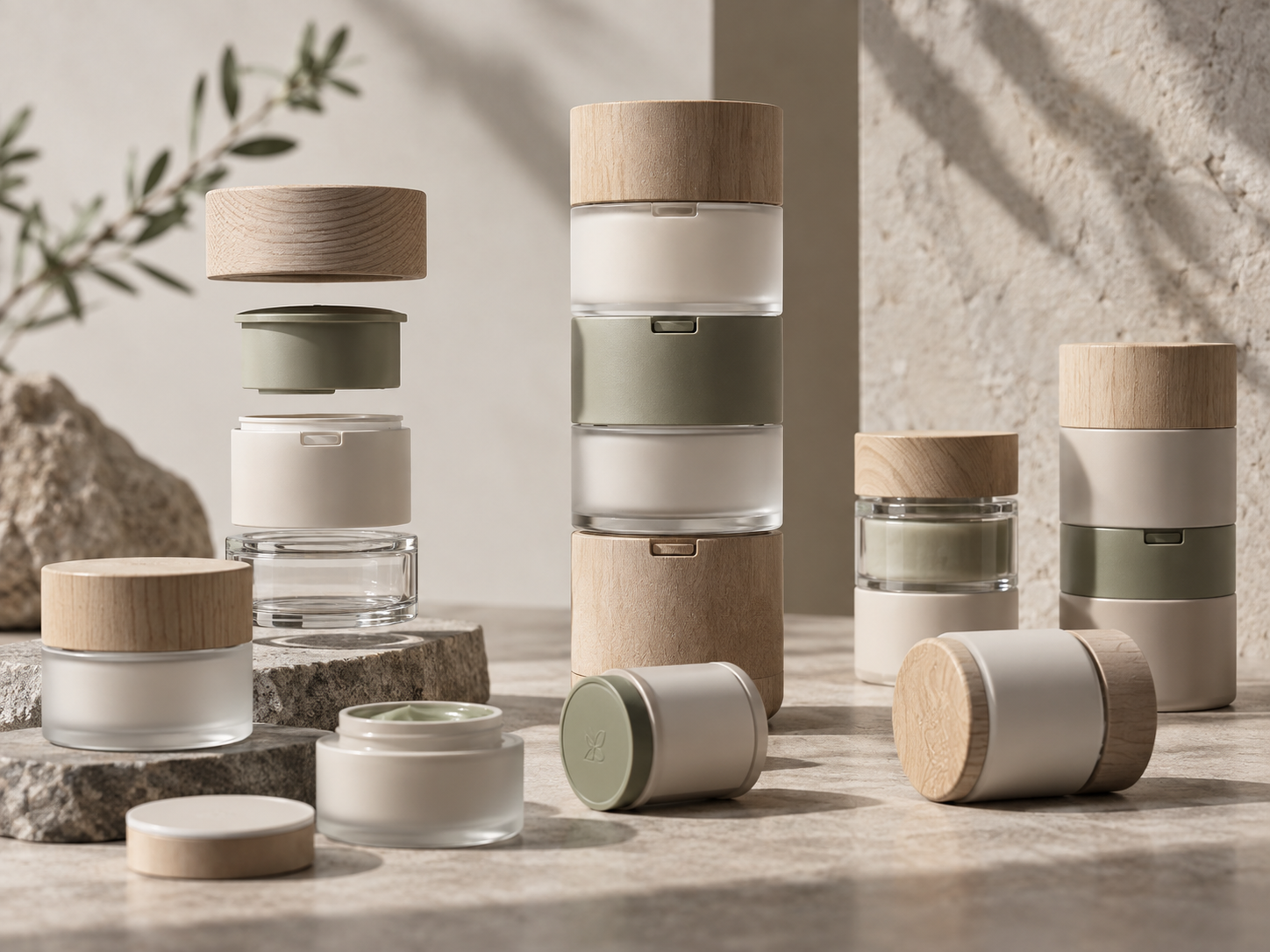
Refillable systems separate a durable outer case, designed to be kept for years, from a replaceable inner core. What began as a luxury feature is moving into mass-market lines as brands look for ways to cut repeat packaging without asking customers to change their routine.
Modular formats extend the same logic further: stackable or snap-together systems that let a customer combine several products into one compact unit, reducing both material use and shelf space.
Trend 4 — Material innovation
Material choice is where most of the visible change in cosmetic packaging design is happening. Glass is regaining ground for its perceived quality and full recyclability. Wood brings a warmth and tactility that plastic and metal cannot replicate, while biochar-based biopolymers offer a compostable alternative that fits existing injection moulding lines without new tooling.
Thread-integrated wood closures are one example of this shift in practice: cutting the screw thread directly into the material removes the internal plastic insert most catalogue caps rely on, producing a mono-material closure that is simpler to recycle at end of life.
Dual-material systems follow the same principle: keep every component separable at end of life instead of fused into one non-recyclable piece.
Trend 5 — Sensorial and tactile design
Packaging increasingly communicates formula quality before a customer ever opens the product. Weight signals substance, a soft-touch finish echoes the promise of a hydrating formula, and the resistance of a well-engineered closure suggests precision before the first use.
This is where material and finish do work that graphics alone cannot: a heavier glass jar or a wood cap with a defined click reads as considered, regardless of the label printed on it.
Trend 6 — Personalization and visual identity
Distinctive silhouettes, limited editions and culturally specific motifs are increasingly used to build shelf recognition and deepen the connection between a product and its audience. A collection built around a consistent design language across skincare, fragrance and home fragrance lines gives a brand a coherent identity that a single hero SKU cannot achieve alone.
Even here, cosmetic packaging design stays tied to material: the same wood closure or glass silhouette, repeated with small variations across a collection, is what makes personalization read as intentional rather than decorative noise.
How to choose a design direction for your brand
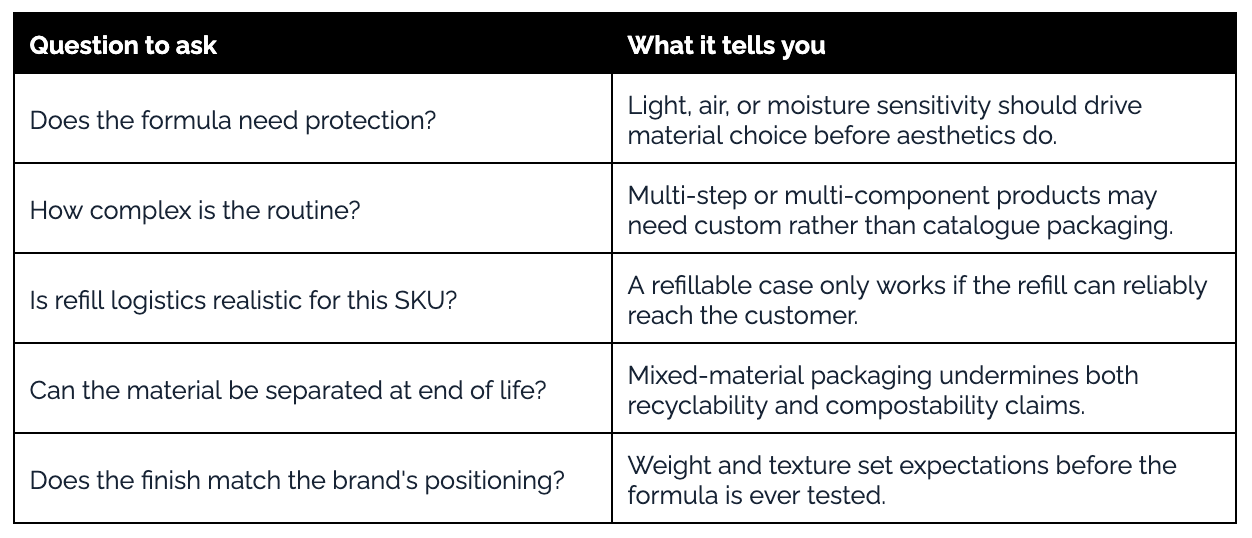
Not every trend fits every brand or formulation. Before committing to a new cosmetic packaging design direction, it helps to test it against a short set of practical questions.
Domande frequenti
What makes cosmetic packaging design innovative?
Innovative cosmetic packaging design solves a real constraint, protecting a formula, simplifying a refill, or cutting material waste, rather than changing only the surface graphics. The most durable innovations are functional first and decorative second.
How is sustainability changing cosmetic packaging design?
Sustainability now shapes material choice from the first sketch: mono-material construction, refillable cases, and compostable biopolymers are considered alongside shape and finish, not added afterward as a certification.
What role does packaging design play in a brand's identity?
Packaging is often the first physical contact a customer has with a brand. Material, weight, closure feel and finish communicate positioning before the product itself is used, which is why design choices carry as much brand weight as the formula.
Can indie or small cosmetic brands access custom packaging design?
Yes. Modular closures, shared mould platforms and smaller minimum order quantities have made custom elements, a distinctive cap or a signature finish, accessible outside large-volume luxury contracts.
What materials are trending in cosmetic packaging design right now?
FSC-certified wood, glass, biopolymers and recyclable aluminum are the materials brands return to most often, each chosen for how it performs across a product's full refill or use cycle.
Where design and material meet
The cosmetic packaging design trends shaping the industry right now share one thing in common: material and mechanism are decided early, alongside the formula, not layered on afterward as styling.
Brands that treat packaging design as part of product development, rather than a finishing step, end up with containers that perform consistently across their full lifecycle: through storage, transport, repeated use and, eventually, disposal.
Related reading: Creative zero waste packaging ideas to inspire sustainable cosmetic brands and
Refillable makeup containers: an eco-friendly trend revolutionizing cosmetics go deeper on two of the directions covered here.
Ready to explore a packaging design built around your formula? Contact us to start the conversation.
